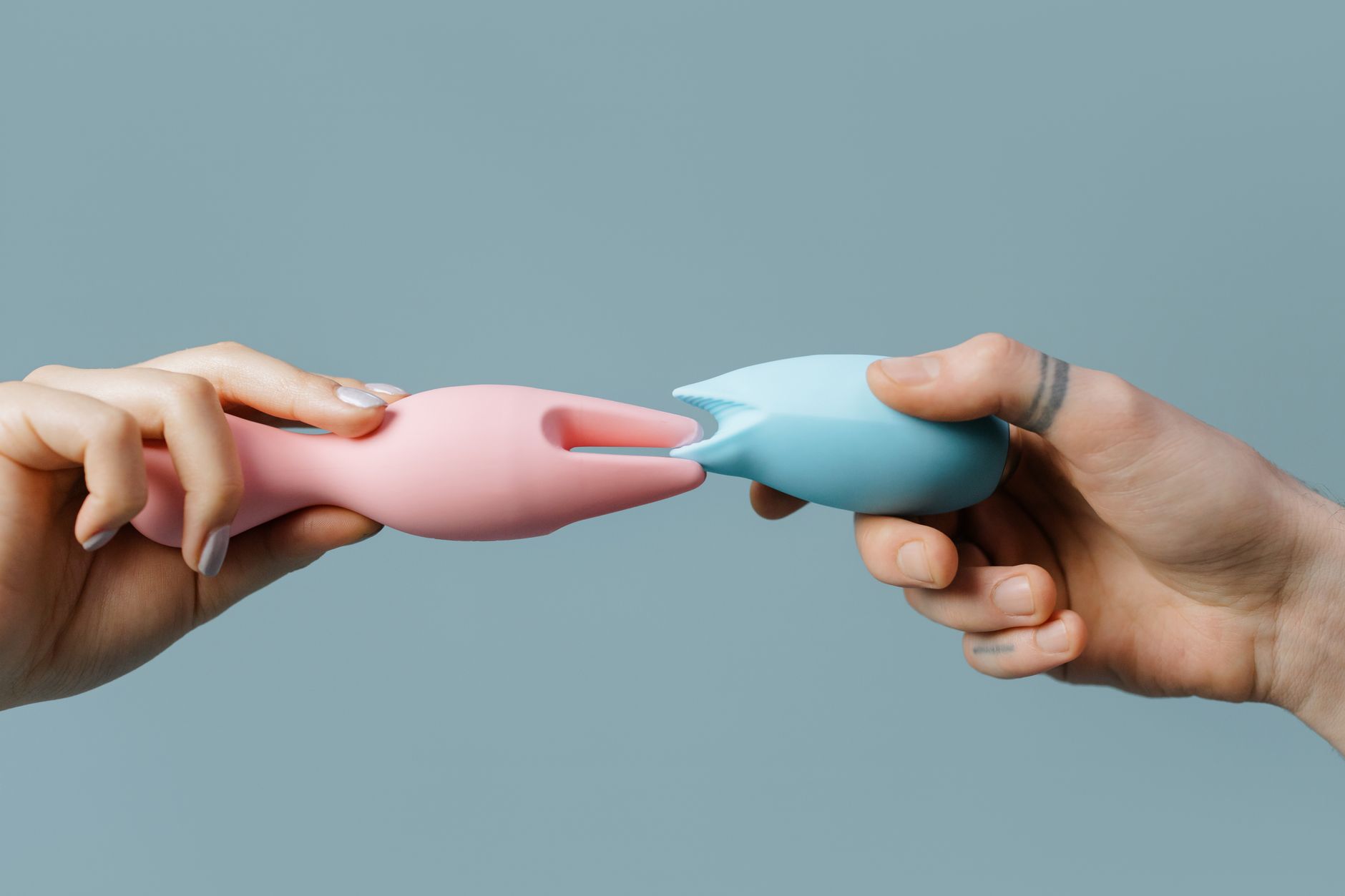
Let's talk about the elephant in the room
Your partner wants to bring a lemon vibrator into your sex life. Maybe they suggested it gently. Maybe they left an article open on their laptop. Either way, you're sitting with a mix of feelings: curiosity, maybe insecurity, possibly relief, possibly dread.
Here's what I know after years of working with couples: this moment is not a problem to solve. It's an opening.
Why your brain is doing what it's doing right now
Introducing any sex toy into partnered sex triggers a bunch of ancient wiring. Your nervous system hears "they want a vibrator" and translates it as "I'm not enough." That's not logic. That's just how human attachment works. We're wired to interpret changes in intimacy as threat signals, even when they're actually invitations.
Here's the reframe: lemon vibrators and other clitoral vibrators aren't replacements for you. They're collaborators. The physiology is simple. During partnered sex, the angle, pressure, and rhythm required for orgasm often don't match what's happening during penetration. A lemon vibrator solves that mismatch. It's not a commentary on your skill. It's physics.
The second thing happening: vulnerability. Asking to use a toy, or saying yes when your partner asks, requires admitting you want this level of sensation. That's intimate in a different way than sex itself. Your brain is flagging that as risky. That's correct. It is risky. And that's exactly why it works.
The conversation you need to have first
Don't jump straight to logistics. Start with curiosity, not defense.
If your partner brought it up, ask them three things:
1. "What drew you to this?" Listen for the actual answer. Sometimes it's "I want to feel you orgasm" or "I'm curious what it would feel like to see you respond that intensely." Those are different from "I'm bored" or "I need you to be more responsive." Both matter, but they need different conversations.
2. "What are you imagining happening?" Are they picturing you using it alone while they watch? During penetration? Are they thinking about using it on you? The image in their head might be totally different from yours. Get specific.
3. "What would help me feel comfortable with this?" This is the one that transforms it from "you want this" to "we want this together."
If you're the one who wants to introduce lemon vibrators, flip it: "I've been thinking about trying this together because [real reason]. Here's what I imagine. But I want to know what feels good to you."
Picking the right lemon vibrator for both of you
This matters more than you think. The wrong toy kills momentum. The right one becomes a regular part of your ritual.
For partnered use, consider these angles:
Size and access. If you're thinking about using it during penetration, you need something compact enough that it doesn't get in the way. The Lemon clitoral vibrator is designed with this in mind. It's small enough for one partner to hold comfortably while the other is inside you, but powerful enough that you actually feel it.
Noise level. If you live with roommates or kids, or just care about discretion, test the decibel situation first. A loud toy can kill the mood faster than any conversation ever could.
Control. Do you want to hold it, or does your partner? Some people find it incredibly hot to let their partner take control of the stimulation. Others need to be the one directing sensation. There's no right answer. Just know which you are before you buy.
Sensation. Lemon sexual toys use suction and pulsation patterns, not vibration alone. That changes the experience compared to a traditional vibrator. If your partner has only experienced buzzier toys, this will feel shockingly different. Different is usually good. But it helps to know it's coming.
The first time: what actually happens
Expect awkwardness. Expect giggling. Expect that the first time you use a lemon vibrator together, nobody will orgasm and that's totally fine.
Here's what tends to happen in order: curiosity (maybe some nervousness), negotiation ("Should we do this now?"), self-consciousness ("This is weird"), then usually relaxation as the physical sensation takes over. By the second or third time, most couples move past the mechanical part and into actual pleasure.
Set one boundary that matters: either person can pause, stop, or change directions without explanation. Not because anything is wrong. Because pleasure is collaborative, and sometimes your body wants something different than it wanted five minutes ago. Permission to change your mind is the foundation of safety in partnered sex.
How to integrate lemon vibrators into your actual rhythm
Most couples find three main uses:
During foreplay. Your partner uses it on you while you kiss, touch, or just be close. This can build arousal faster and lets you both get comfortable with the sensation before anything else happens.
During penetration. Partner holds it or you do while they're inside you. The angle matters here. You're not trying to move it around a lot. Usually you find one spot and let the pulsation do the work. Communication is key: "A little left" or "Stay right there" becomes part of the conversation you're already having.
After penetration. Some people use lemon clitoral vibrators to finish after partnered sex. This is wildly common and nothing to feel weird about. Your orgasm doesn't have to look like theirs.
The biggest mistake couples make is treating the lemon vibrator as the main event instead of a supporting player. It works best when it's integrated into what you're already doing, not presented as the star attraction.
What to do if one of you feels weird about it
This is not something you "get over" or "just relax about." Discomfort in partnered sex deserves attention.
If you're uncomfortable:
Get curious about the specific discomfort, not the general one. "I feel weird about toys" is too broad. "I feel like I'm being compared" or "I feel like I should be enough" or "I'm embarrassed about how much I respond" are real things to work with. Name it, and your partner can actually help.
Start smaller than you think. If the idea of using a lemon vibrator during penetration feels overwhelming, start with your partner using it on you while you're kissing, no penetration involved. Build the comfort gradually.
Remember this is also new for them. Your partner is probably also nervous about how this will feel, whether you'll like it, whether it will change what you have. You're not alone in the vulnerability. You're in it together.
If your partner is uncomfortable:
Don't convince them. Instead, get specific about what's actually bothering them. Sometimes it's not the toy. Sometimes it's that they're worried about performance or feeling replaced. Sometimes it's just sensory overwhelm. Those are all different problems with different solutions.
Consider using the toy solo first. Let them watch (if that feels okay) and see what actually happens. Sometimes seeing your pleasure is way less threatening than imagining it.
Take time. There's no timeline for this.
What actually changes (and what doesn't)
Honestly, the physical part is the smaller shift. What changes is the permission structure. Using lemon vibrators together is saying "we care about your actual orgasm, not a performance of one." That's radical in a lot of relationships. And once you've said that, you can't unsay it.
Partners report that introducing clitoral vibrators actually increases intimacy. Because you're communicating more specifically about pleasure. Because you're admitting what actually works. Because you're prioritizing sensation over ego.
What doesn't change: your body's attachment to this person. Your responsiveness to them. Your desire for them. The things you already know about what they like and how they touch you. A lemon vibrator doesn't compete with any of that. It completes it.
The conversation you have after
This is the one most couples skip. Don't.
After you've used a lemon vibrator together, talk about it. Not in a "review" way. More like "How did that feel for you?" and "What would you want to try next time?" and maybe "I felt [vulnerable / connected / aroused / weird], did you?"
These aren't heavy conversations. They're just check-ins. But they're the ones that turn a onetime experiment into an integrated part of your intimacy.
A note on pressure and timeline
If your partner suggested this and you're not ready, that's completely valid. You don't owe anyone access to your body based on a timeline that isn't yours. "I'm not ready yet, but I'm open to trying eventually" is a full sentence. If your partner respects it, that's important information. If they pressure you, that's also important information.
If you brought this up and your partner said no, that's information too. The conversation doesn't have to end there. But it does have to include their actual feelings, not just their reluctance.
Introducing lemon sexual toys into your partnership is a small thing. It's also a big thing. It's an opportunity to talk about pleasure, to admit vulnerability, to collaborate on sensation instead of performing for each other. That matters.
Frequently asked questions
Will using a lemon vibrator during sex make my partner feel less needed?
Not usually. Most partners report feeling more needed, actually. Because they're watching your body respond at a level they might not have seen before. Because they're participating in something you asked for. And because your actual pleasure matters more than a performance of it. The insecurity is real, but it doesn't match what usually happens in reality.
Can you use lemon vibrators during penetration with a condom?
Yes. The condom doesn't change how a lemon clitoral vibrator works because it's not making contact with the shaft. It's focused on the vulva. That said, watch for the condom shifting slightly. Some partners hold the base of the penis with one hand while using the vibrator with the other, which keeps things stable.
What if we only want to use it sometimes, not every time?
Perfect. That's how most couples use lemon vibrators. They're tools for specific moments or specific needs, not requirements. Some people use them when they're tired and want to get there faster. Some use them when they want more intensity. Some use them because it's Tuesday and they want to. None of those are wrong.
How do you decide who holds the lemon vibrator during sex?
Whichever of you wants to. Sometimes you take turns. Sometimes one person always prefers to hold it. Sometimes you use it on yourself while your partner does something else. The logistics should serve your pleasure, not the other way around. Talk about it, try different configurations, and keep what works.
What if orgasm takes longer with a lemon vibrator in the mix?
That's usually a sign of nerves or overthinking, not the toy. The first time you use anything new, your nervous system is on alert. That makes orgasm harder, not easier. By the second or third time, most people relax into it. If you're still struggling, check in: are you trying too hard? Are you comfortable? Is the angle right?
Is it normal to feel insecure after bringing up lemon vibrators with a partner?
Completely normal. Introducing anything new into sex triggers vulnerability. That doesn't mean you made a mistake. It means you're doing something brave. The insecurity usually fades once you actually try it and realize it doesn't change how your partner feels about you.
Introducing lemon vibrators into your partnership is an act of collaboration. It says "I trust you with my pleasure." It says "your orgasm matters." It says "we get to figure this out together." That conversation, the one that starts with vulnerability and moves toward pleasure, is the real intimacy. The toy is just the tool.
If you want to explore this further or work through specific concerns with your partner, reach out to The Lemon Sex Toys team. Sometimes having a space to ask questions without judgment helps.